 |
Research Magazine > ARCHIVE > Summer
97 > Article
A Sharper Focus on Antiquity
by Catherine Gianaro
Ted Lewis is reconstructing history with the help of some
fancy camera work, a computer and a cache of 3,400-year-old clay tablets.
Those may seem an odd assortment of items in the arsenal of a professor of
ancient religion, but the combination is important to correcting seven decades
of misunderstanding.
Lewis is part of a worldwide team called the West Semitic Research Project,
which is deciphering the original readings of the Ugaritic tablets. The tablets
were inscribed in a cuneiform, or wedge-shaped script, used by the people
of the city of Ugarit in ancient Syria. The tablets, which number in the
thousands, date to the 14th century B.C. and constitute the only surviving
collection of Canaanite religious and literary texts.
French archaeologists started uncovering the tablets in the late 1920s in conjunction
with Syrian authorities, which is why half the tablets are housed in the Louvre
in Paris, and the other half remain in Syria, in the national museums in Damascus
and Aleppo. For the past 70 years, scholars have been studying and deciphering
the tablets - yet some of the readings are anything but certain.
Two main editions of the tablets have been published, but they sometimes contradict
each other, and neither provides usable photographs for scholars to judge for
themselves which reading, if either, might be correct.
"The originally published photos were of very poor quality, but they were
the only thing scholars had to work from unless one went to Syria and looked
at the originals," Lewis said. "Some texts have been misread for years.
The problem is, nobody had gone back to really check the readings."
For example, in 1960, the French translator Charles Virolleaud published
a reading of a small, broken tablet known as KTU 1.96. The fuzzy photograph
that
accompanied his translation wasn't sufficiently clear to permit scholars to
interpret the evidence from these ancient inscriptions for themselves. "They
had no choice but to accept Virolleaud's interpretation of the reading," Lewis
said.
Virolleaud translated the first word as "Anat," who was a warrior
goddess known from other Ugaritic texts. The text goes on to describe someone
eating something. "So scholars thought the goddess Anat was a cannibal
warrior [since] there's some anthropological literature about how if you eat
somebody, then you ingest their power, becoming stronger," he said. "So
for 37 years, everyone has been writing about this aspect of the fascinating
goddess Anat."
But the reading was wrong.
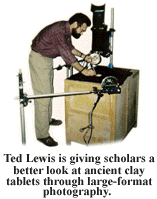
Using a large-format camera with 4-inch by 5-inch negative film and "key
and fill" side lighting, Lewis and his colleagues photographed the KTU
fragment while in Damascus. The result was staggering.
"When we went back and analyzed the photograph, we found that the 't' of "Anat" isn't
even there. And it's the only time in the whole text that that word occurs," Lewis
said. "Without this one letter, the goddess disappears from the text.
"Just by correcting one letter, we've thrown out 37 years' worth of scholarship.
So it shows the importance of getting the text read right," he said.
The project's ongoing discoveries and new interpretations of the stories and
myths of the people of Ugarit could alter our understanding of the history
of our own religions - in fact, of religions followed by more than one billion
people today.
"The tablets give us the background into the world in which the Old Testament
grew up," said Lewis, who presented this work in the June 1996 issue of
the journal Biblical Archaeologist.
Ancient Israel in biblical times was roughly in the same area as present-day
Israel. About 150 miles away, the city of Ugarit was built on what is now the
northern coast of Syria. "The Ugaritic texts have opened up new windows
into what is usually referred to as 'Canaanite religion,'" Lewis said.
"The Bible is polemically written against the Canaanites. The tablets reflect
the type of practices that the biblical authors wrote against," he said. "Suddenly
we have their side of the story to fillin the whole picture.
"The tablets have revolutionized the study of the Hebrew Bible in a way
that far surpasses the contribution of the Dead Sea Scrolls. They have improved
our understanding of how Israel was both similar to and distinct from the cultures
that preceded and surrounded it.
"The Bible says, 'As it's written in the book of the wars of Yahweh' (Numbers
21:14). Well, we don't have that book. "As it's written in the book of Yashar" (Joshua
10:13; 2 Samuel 1:18). We don't have that one either," Lewis said. "We're
missing a lot of material from antiquity because [the Hebrews] didn't write on
non-perishable material. Right next door, they did. And they used a lot of the
same vocabulary and a lot of the same images and motifs. So we can use one culture
to uncover another."
The oldest biblical manuscripts - the Dead Sea Scrolls - only date to the
1st century B.C. The Ugaritic texts are 14th century B.C. The tablets do
not have
dates inscribed on them, but "we know that [Ugarit] was destroyed by the
Sea Peoples who came during the Late Bronze period and destroyed a lot of the
area," he said. "That's why [the tablets] are all broken. So we have
to take the bits and pieces they left behind and try to put the puzzle back
together again.
"Stories [from the Old Testament] are around this time. David is around
the year 1000 and Moses, around the 13th century. But we don't have texts preserved,
just copies of copies," Lewis said. "As far as the whole culture -what's
going on religiously, politically, economically - the tablets give us a better
window."
Just as the Ugaritic texts promise to improve interpretation of history, the
work of Lewis and the West Semitic Research Project will give scholars worldwide
a better window on the original texts.
"We're giving scholars the opportunity to decipher for themselves, rather
than taking someone else's word for it," Lewis said. "They may not
be able to travel to Damascus, but they'll have such clear photos, they'll be
as good as holding the originals in your hand."
Lewis joined the project nearly two years into the study. But with a grant
from the University of Georgia Research Foundation, Inc., he was able to go
to Syria in March 1995 to help photograph the tablets. University of Southern
California religion Professor Bruce Zuckerman spearheads the project, along
with University of Illinois religion Professor Wayne Pitard. Both men are experts
in the Ugaritic language.
"I also specialize in the Ugaritic language, so they invited me to join
the project," Lewis said. "What we do is actually called epigraphy,
which is the study of ancient inscriptions."
The French archaeologists who direct the 50-acre excavation in Syria have
given them plenty to do. "It's an incredible site," Lewis said. "It's
huge. It seems every time they dig, they come out with more texts. Two years
ago they found 400 more tablets."
The analytical team has photographed all of the mythological texts published
to date and now are working on a digital edition, which they plan to publish
in the year 2000 on CD-ROM. For this, the researchers are using high-resolution
scanners to produce better-than-life digitized photographs.
"We then can manipulate the images on the computer," Lewis said. "With
standard computer programs, you can do everything you want as far as darkening
shadows, cleaning up shadows, or manipulating the image's brightness and contrast
to get a better look at it."
The team announced the digital edition at the November 1996 joint meeting of
the Society of Biblical Literature, the American Academy of Religion and the
American Schools of Oriental Research.
"As a textual critic, one always strives to improve our understanding of
the history of a text and its transmission. That's the foundation upon which
all studies are built," Lewis said. "It all depends on establishing
the best text possible. If you have mistakes in the text, then everyone who uses
it will have mistakes in their interpretations."
TIMELINE
BC
6000 BC Widespread domestication of animals
3400 BC Cuneiform writing develops in Mesopotamia
3150 BC Egyptians begin to develop hieroglyphic writing
1500 BC Hittites introduce iron weapons
14th-13th Centuries BC Ancient Syrians write Ugaritic tablets
1300s BC Chinese writing develops
late 1200s BC Moses leads Hebrews out of Egypt
1010 BC King David reigns in Judah
776 BC 1st Olympic Games in Greece
431 BC Peloponnesian Wars begin
206 BC China's Han Dynasty begins
1st Century BC People of Qumran community write Dead Sea Scrolls
51-30 BC Cleopatra rules Egypt
4 BC Birth of Jesus Christ in Bethlehem
AD
2nd Century Invention of paper in China
410 Sacking of Rome
800 Charlemagne is crowned Emperor of the Franks
1100 Height of Maya civilization
1206-1227 Genghis Khan rules the Mongol Empire
1348 Black Plague hits Europe
1607 First British settlement in North America
1818-1828 Shaka's Zulu Kingdom rules southern Africa
1929 Start of French excavations of Ugaritic tablets in Syria
For more information, access http://www.usc.edu/dept/LAS/wsrp/,
or e-mail Ted Lewis at lewis@uga.cc.uga.edu.
Catherine Gianaro, a former UGA assistant director of research communications,
is an award-winning, Atlanta-based freelance writer.
Return to Summer 1997 Index
Research
Communications, Office of the VP for Research, UGA
For comments or for information please e-mail the editor: rcomm@uga.edu
To contact the webmaster please email: ovprweb@uga.edu
|
| |

|
|
|
|
|
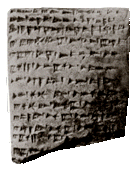
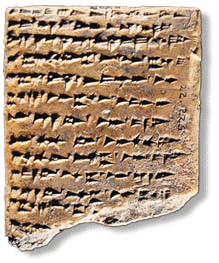
Before computers and large format photography, scholars solely based
their interpretations of clay tablets,such as this one, on poor black
and white photos (top). Now, they can study these ancient writings
in unprecedented detail while never having seen the tablets in person
(bottom).
|
|
|
|
|









